Back to HistoryCake Driving Tour - Hwy 14-395 - Introduction and Overview
Lyon's Station stagecoach stop
Traversing the border between Newhall and Valencia, and stretching from the fast food restaurants of "Hamburger Hill" along Interstate 5 to the tracks at Railroad Avenue, is a road named after two brothers from Maine who became early pioneers of the Santa Clarita Valley.
Story 4 of 37
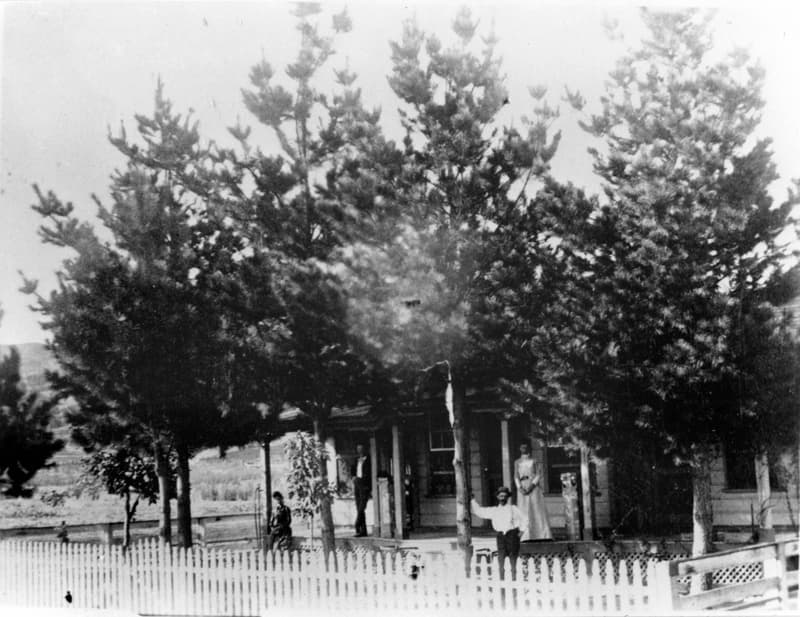
Some have claimed that "Lyons" Avenue is actually a misnomer, as it is named for Sanford and Cyrus Lyon.
The Lyon brothers were twins born to Henry and Betsy Lyon in Machias, Maine, in 1831. Their ancestor, another Henry Lyon, had emigrated to the English colony of Connecticut in 1648.
As with many of California's pioneers, the Gold Rush lured the Lyon brothers away from their east coast home in 1849. They traveled on a ship named Oxnard from Maine, taking the long way around Cape Horn at the tip of South America. Instead of following the usual route to the gold fields of Northern California, the brothers ended up in the tiny pueblo of Los Angeles where they first worked as clerks at Alexander and Mellus, a mercantile store partly owned by their first cousin, Francis Mellus.
Lyons Station and the Butterfield Stage
After a few years, Sanford and Cyrus had bigger plans. An old stage depot at the base of the Fremont Pass on the Rancho San Francisco " the site of today's Eternal Valley Cemetery — was purchased by the brothers came to be known as Lyons Station.
A few years prior, John Butterfield established the Overland Mail route with its first run from Tipton, Mo., to San Francisco on September 16, 1858. Lyons Station — then known as Hart's Station for then-owner Josiah Hart — became a regular stop on the famous route. Contemporary reports claimed the Fremont Pass was the most difficult crossing of the entire route.
Butterfield was forced out of the business in 1860, when the route was taken over by Wells Fargo. In anticipation of the Civil War, Congress voted to discontinue the southerly Butterfield Route in March 1861, replacing it with the Central Overland California Route between St. Joseph, Mo., and Placerville, Calif.
Lyons (Hart's) Station, which started as a meal and rest stop on the Butterfield line, eventually grew into a multi-use complex consisting of a depot, tavern, store, telegraph office and post office.
Cyrus Lyon and the Los Angeles Rangers
While Sanford primarily took care of the business at Lyons Station, Cyrus led a busy life in the Los Angeles pueblo.
The Los Angeles of the early 1850s represented the epitome of the Wild West and was considered the most dangerous town in America. A volatile mixture of American and Irish gold seekers, Mexicans, Californios and Native Americans resulted in an astounding 44 homicides between July 1850 and October 1851 in a town with a population of about 1,600 people.
By 1853, the law-abiding citizens of the pueblo had had enough. During the tenure of Mayor Ygnacio Del Valle, a volunteer mounted police unit called the Los Angeles Rangers was established and partly funded by the state Legislature. One of the founding members of the Rangers was an Indiana-born Southerner, Horace Bell.
Bell had come to California seeking gold in 1850. He moved down to Los Angeles two years later where he married a Californio woman and became active in politics.
After helping form the Rangers, Bell appointed 21-year-old Cyrus Lyon as a Captain. Another captain was William W. Jenkins, a future resident of the Santa Clarita Valley and participant in the long-running Castaic Range War.
The 60 active members of the Rangers, under the command of Captain A.W. Hope, served as a relentless fighting unit, which effectively cleaned up the lawless streets of Los Angeles within two years. Lyon was considered one of the most efficient of the Rangers. Bell later wrote the first book published in Los Angeles, a memoir of his life in the pueblo called "Reminiscences of a Ranger" (1881).
During the 1850s, Cyrus Lyon also became one of the first American property owners in Los Angeles and the San Fernando Valley with purchases in the Ranchos Cahuenga, Los Feliz and Providencia. Cyrus was to have a son, Jose Enrique, known as Henry Lyon, whose mother was Californio native Nicolasa Triunfo, a descendant of one of the original 11 families who settled Los Angeles in 1781.
A present-day descendant of Henry and great-great-granddaughter of Cyrus Lyon, Victoria Carrillo Norton, has spent many years compiling a genealogy of her family and has provided much of the information that we know about the Lyon brothers today.
Tour Route
You are here

Experience This Story On Location
Download the History Cake app to experience this story with automatic audio narration as you visit the location.