Back to Oahu Driving History Tour
Nu'uanu Pali fortification and battle
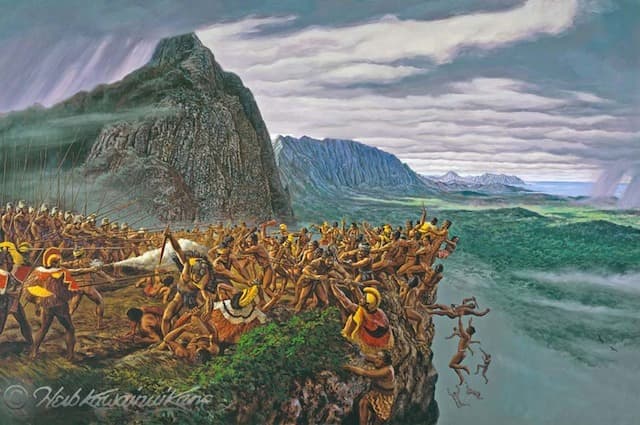
Notches on the crest of the ridge for cannon and warriors for centuries. The Battle of Nuʻuanu (Hawaiian: Kalelekaʻanae; literally "the leaping mullet"), fought in May 1795 on the southern part of the island of Oʻahu, was a key battle in the final days of King Kamehameha I's wars to conquer the Hawaiian Islands. It is known in the Hawaiian language as Kalelekaʻanae, which means "the leaping mullet", and refers to a number of Oʻahu warriors driven off the cliff in the final phase of the battle.[2] There are "varied and sometimes conflicting histories of the Battle of Nuʻuanu."
Story 8 of 25
Kamehameha I had begun his campaign to dominate the island chain under his rule in 1783, but prior to 1795 had only managed to unify the island of Hawaiʻi (the "Big Island"). However, the civil war on Oʻahu after Kahekili II's death left the Oʻahu kingdom greatly weakened.
During this time, Kamehameha had been equipping his army with modern muskets and cannons, as well as training his men in their use under direction of British sailor John Young.[7] In February 1795 he assembled the largest army the Hawaiian Islands had ever seen, with about 12,000 men and 1,200 war canoes. Kamehameha initially moved against the eastern islands of Maui and Molokai|Molokaʻi, conquering them in the early spring of 1795. Then he invaded Oʻahu.
Battle
The Battle of Nuʻuanu began when Kamehameha's forces landed on the southeastern portion of Oʻahu near Waiʻalae and Waikiki. After spending several days gathering supplies and scouting Kalanikupule's positions, Kamehameha's army advanced westward, encountering Kalanikupule's first line of defense near the Punchbowl Crater. Splitting his army into two, Kamehameha sent one half in a flanking maneuver around the crater and the other straight at Kalanikupule. Pressed from both sides, the Oʻahu forces retreated to Kalanikupule's next line of defense near Laʻimi. While Kamehameha pursued, he secretly detached a portion of his army to clear the surrounding heights of the Nuʻuanu Valley of Kalanikupule's cannons. Kamehameha also brought up his own cannons to shell Laʻimi. During this part of the battle, both Kalanikupule and Kaʻiana were wounded, Kaʻiana fatally. With its leadership in chaos, the Oʻahu army slowly fell back north through the Nuʻuanu Valley to the cliffs at Nuʻuanu Pali. Caught between the Hawaiian Army and a 1,000-foot (305-meter) drop, over 700 Oʻahu warriors either jumped or were pushed over the edge of the pali (cliff). In 1898 construction workers working on the Pali road discovered 800 skulls which were believed to be the remains of the warriors that fell to their deaths from the cliff above in 1795.[8]
Audio Narration
Tour Route
You are here
Story 8 of 25

Experience This Story On Location
Download the History Cake app to experience this story with automatic audio narration as you visit the location.