Back to Sphinx Ranch Walking Tour
The early history of the Sphinx Ranch land and how it becomes William Allen's
An overview of the varied peoples who have lived upon and used the land of Northeastern Altadena and Eaton Canyon's waters. From pre-contact native populations to the early 1900's with special attention paid to the 1880's, when the William Allen family comes to farm and live on the alluvial fan upon which our neighborhood sits today.
Altadena, CAStory 4 of 17
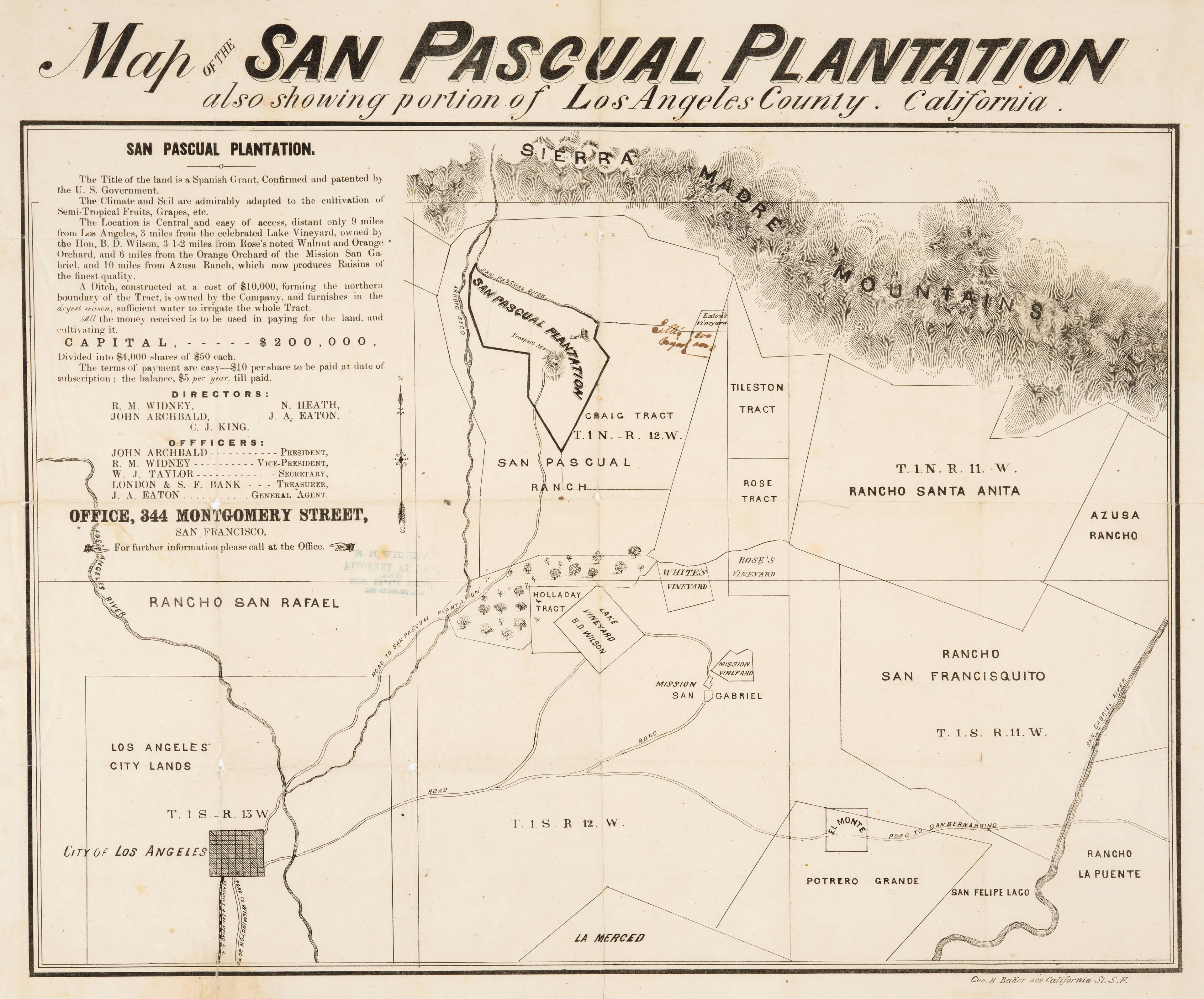
As we walk up Pepper street towards berendo and turn right, we can step back in time and put ourselves out to sea between Santa Catalina island and land and through our spyglass see the alluvial fan spreading beneath the San Gabriels with a skirt of spring poppies. This view could be seen by Captain Juan Cabrillo entered what is now Santa Monica Bay in 1542. La sabanilla del oro the spaniards called the setting, the altarcloth of gold. Their log is the first mention of the lands which would become Altadena.
Native Americans lived in the Eaton and the Arroyo Seco canyon mouths where oaks and acorns were plentiful and game abounded for centuries before the bearded white men came to the harbors and shores they knew so well.
The first inhabitants of the land that would become Altadena were the Hahamongna Tongva tribe of native americans who lived here at least 8000 years ago and perhaps as long as 10000 years BC. They hunted rabbits and antelope and coyotes and gathered acorns and had major villages in both Eaton Canyon and the Arroyo Seco. The coastal live oak delivered acorns and the presence of running water through the canyons brought the mammals nearby.
When first seen by Cabrillo in 1542 from Santa Monica Bay, the natives were conducting a rabbit hunt by burning low brush and herding the rabbits. Above the smoke from their fires, he could see a bright line of orange skirting the distant mountains and La Sabanilla del Oro was the first european description of what would become Altadena 300 years down a slow and pastoral road paved by the spanish.
Nearly all good farming and ranching land in California was covered by deeded ranchos by 1850, when California is granted statehood. The boundaries of these large ranchos were blessed by the governor of Alta California at the time and granted to petitioners who were deemed worthy - nearly all retired military personnel from the DeAnza and Portola expeditions of the 1770's. Once Spain learned how large the landmass they had laid claim to, they had to defend and populate it. In theory, the spaniards would establish a mission and presidio system at distances apart that could be covered in one day of average (for the time) travel - about 30 miles. The presidios had soldiers and weapons and the mission had Franciscan friars to educate the native populace in agriculture and the ways the Christian faith. They were tasked with teaching the natives about agricultural cultivation and the teachings of their savior via the construction of the missions and ranching cattle on their surrounding plains. While perhaps noble in its intent, in actuality it was the first striking blow to native populations in California as European brought diseases decimated their perplexed immune systems.
Within 300 years of Cabrillo's first european sighting and only one hundred of spanish occupation, the most populous part of america in terms of native tribes (over 300 tribes and 300 thousand natives) had been reduced by over 50 percent through disease and other debilitating circumstances. The gold rush would further reduce their population and statehood in 1850 would deliver the final blows.
Before the gold rush in 1849, the non-native population of all of California was around 15000 people of Mexican and Spanish descent, and probably around 100,000 native americans. For perspective, in 2024, Altadena had nearly three times that many people living in her environs. In 1849, nobody lived in Altadena, it was part of a vast rancho owned by Manuel Garfias, and about to be sold to enterprising new arrivals, the biggest of which married into Spanish society in the 1830s and purchased the San Pascual Rancho and its upper northeast corner which would become Altadena. A vast tract of what they thought was waterless and useless land - until one Benjamin Eaton became involved with Don Benito Wilson after whom the tallest peak due north is named.
The mission system seeking to educate the natives was discontinued when Mexico declared its independence from Spain and took over Alta California and the land holdings contained therein. The system of land grants begun by Spain to reward its earliest soldiers upon retirement gave way to dissolution and division of mission lands and the scattering of the native populations who worked these most valuable of village sites. In 1833, Mexico freed itself from Spanish Governance and took over the land of Alta California. The first governor, Figueroa, granted the San Pascual ranch to Eulalia and her husband, Juan Marine.
Marine and Eulalia sold to Manuel Garfias who then went broke and a little beyond building his adobe ranch home down by Arroyo Seco golf course in South Pasadena. The men who lent him the money Don Benito Wilson and a friend local judge in Los Angeles, Benjamin Eaton and his brother in law, John Griffin, soon took ownership.
This third partner in the rancho land in the 1860s was Dr John Griffin, a southern physician whose brothers in law were Confederate Civil War General Albert Sydney Johnston and Benjamin Eaton who was a judge and very capable settler who had a way with water. These were the first residents of this eastern side of Altadena and Judge Eaton built the first home under the oak trees between what is now New York and Washington Drive, just on the west side of Pepper. He also planted and farmed grapes without irrigating them (dry farmed them), but later bringing water from the canyon that bears his name.
In 1879, the year in which William Allen will purchase the land that becomes his beloved Sphinx Ranch, all of Altadena has fewer than 100 residents and only 7 or 8 homes west of Lake. There are no businesses located in the area and there is no post office. These conveniences are available down the hill in Pasadena, a growing community of about 20 years at that point. Growing oranges and both table and wine grapes are in vogue and newcomers hoped to make their small fortunes with virgin lands and a healthful climate.
So as you stand wherever you are in the old boundaries of the Sphinx Ranch, look around you and imagine not a single home and all of the surrounding oak trees and occasional sycamore. Imagine native grass and poppies in profusion for as far west as you can see across the barren slope. There is only one road coming across the entire alluvial fan and it heads across Eaton's canyon mouth and arroyo to the sierra madre villa hotel, a sanitarium with a great reputation for healing tuberculosis sufferers. Other than that, just Ben Eaton's home and oak trees and some vines he was experimenting with...
Audio Narration
Tour Route
You are here
Experience This Story On Location
Download the History Cake app to experience this story with automatic audio narration as you visit the location.